


Anthropic Exposes an AI-Powered Disinformation Network Targeting the DRC-Rwanda Conflict
In September 2026, Anthropic, the company behind the AI model Claude, said it had disrupted a disinformation network that used its model to mass-produce fake news articles, including 318 about the Democratic Republic of the Congo (DRC). The network, attributed to LKM Company, a France-based digital advertising agency, published on around 70 fake news sites amplified by hundreds of inauthentic X accounts. Its DRC content generally supported the Congolese government’s position against Rwanda.
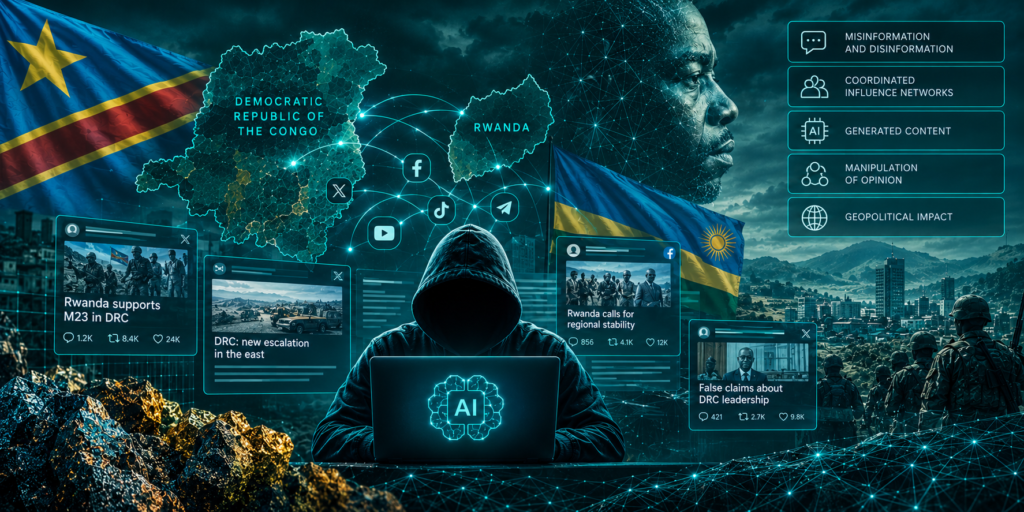
The case shows how far things have moved: with AI, a small operation can now run the equivalent of a full newsroom, with fake journalists, fake outlets and fake readers. In a conflict where information is already a weapon, that’s a concrete risk for anyone who makes decisions based on what they read.
| Key fact | Detail |
| Source | Anthropic, “Detecting and countering misuse of AI”, September 2026 (operation tracked as GTG-54002) |
| Operator identified | LKM Company, a France-based digital advertising agency |
| Network | Around 70 fake news sites, 70 linked X accounts and more than 250 inauthentic commenting X accounts |
| Volume | At least 8,913 articles in about 20 languages, including 318 on the DRC |
| Target countries | The United States, Brazil, France and the DRC, among others, across six continents |
| Clients | Unknown; no evidence of direction by any government |
| Measured impact | Low: Category Two out of six on the Brookings Institution’s Breakout Scale |
What does Anthropic’s report reveal?
The report describes an “influence-as-a-service” operation: a private company selling information manipulation to clients, much as it would sell an advertising campaign.
Anthropic says it identified and closed an account that used Claude to mass-produce and rewrite political content. Behind that account, its investigators uncovered a network of around 70 sites presenting themselves as independent local newsrooms, with names such as Naija Pulse, Jambo Journal and Echo Berlin. Each site was paired with an X account, and the whole network was amplified by more than 250 inauthentic commenting accounts, many using AI-generated profile photos.
Investigators were able to link these seemingly independent sites to a single operator: the domains had been registered from France within a ten-week window in mid-2025, and all were hosted on the same infrastructure. They attributed the operation to LKM Company, a France-based digital advertising agency.
One point is key to understanding the case: the network had no political line of its own. According to Anthropic, it shifted positions depending on who was paying. It also targeted very different countries, including the United States, Brazil, France and the DRC.
How was AI used?
According to the report, the operator used Claude in two ways: to write entirely original articles for its fake outlets, and to rewrite real articles by legitimate journalists into politically slanted versions tailored to each national audience.
The operation ran on an automated production line. Every request demanded a fixed format, with exact length limits and three to four internal links per article, so content could be generated and published at scale. The articles were also designed to boost the sites’ search engine rankings.
The report identifies three recurring manipulation techniques:
- Rewriting the same story in opposite directions for different audiences.
- Adding a political angle to stories that originally had none.
- Recycling stories across borders, stripped of their original context.
To look credible, the articles were signed with the names of journalists who don’t exist. Anthropic spotted signs of coordinated inauthentic behaviour on 11 September 2025, when several of the network’s sites published almost identical articles about the DRC-Rwanda conflict within three minutes of each other, each adjusted in tone for its regional audience, and pushed the links out across many X accounts at the same time.
What does the report say about the DRC and Rwanda?
The DRC stood out in the network’s activity. Anthropic counted 318 articles about the country across all the fake sites. They generally supported the Congolese government’s position, particularly on regional mineral deals and tensions with Rwanda.
The audience followed the same pattern. In the first few weeks, most of the fake personas following the network’s X accounts were linked to the DRC, and its DRC news page became the most shared and most popular account in the whole operation. An X account presenting itself as a Congolese civilian “digital army” also followed several of the network’s accounts.
Anthropic says it found signals that the activity might reflect the interests of one or more clients with a stake in the DRC-Rwanda conflict. It adds that it can’t independently confirm which clients commissioned the content, and that it found no evidence of direction by any government.
The operation came into an information environment that was already badly degraded. Speaking to Global Voices, Hobab Watukalusu, a fact-checker at Soma Média Lab in Kinshasa, said disinformation around DRC-Rwanda relations has weakened the DRC’s public and diplomatic standing and fuelled hatred towards Rwandans.
What doesn’t the report say?
Since its publication, the report has been cited in the dispute between Kinshasa and Kigali, sometimes well beyond what it actually establishes. Three limits are worth keeping in mind.
- 6041991 The report attributes the running of the operation to LKM Company, but it doesn’t say who paid for it. Articles favourable to Kinshasa aren’t enough to name a client, and Anthropic says it found no evidence of direction by any government, Congolese or French.
- LKM Company isn’t described as a party to the conflict. The report describes a commercial agency whose positions changed with its clients, and which also worked on other countries.
- The impact stayed limited. Anthropic disrupted the operation early, before it could build a genuine audience. Most of the content drew little authentic engagement, and the report rates the operation Category Two out of six on the Brookings Institution’s scale: the content stayed within the network’s own sites and accounts and didn’t break through into public debate.
What the report shows most clearly is what’s now possible: producing nearly 9,000 articles in about 20 languages, complete with fake journalists and fake readers, with very few people and at low cost.
Why does this matter for companies and investors?
Even when it reaches few people, AI-generated disinformation creates direct risks for organisations operating in the DRC or the wider Great Lakes region.
- Decisions based on false information. A monitoring system that pulls in news sites without checking them can absorb fabricated articles. A fake outlet that ranks well on Google, with a journalist’s byline and a polished website, can pass for a credible local source.
- Mining is a prime target. The network’s DRC content focused on regional mineral deals. Mining companies, their partners and their buyers can find themselves at the centre of narratives built to serve interests they don’t know about.
- Reputational risk. A company can be named, attacked or used in fabricated articles, which other sites may then pick up.
- Eroding trust. In an environment crowded with fake outlets, genuine information is doubted too. It becomes harder to tell a real warning sign from a manufactured rumour.
Anthropic’s report points to a broader trend: AI lets actors with few resources run influence operations at a scale they couldn’t reach on their own. LKM Company is unlikely to be the last case in the region.
How can you spot a fake news outlet?
The methods described in the report leave traces. Before relying on an unfamiliar source, a few simple checks will rule out most fake outlets:
1. Check the site’s age. All of the network’s sites were created within a few weeks. An outlet that presents itself as established but whose domain is less than a year old deserves caution. WHOIS lookup tools show the registration date.
2. Compare with other sources. Important news about the DRC is usually picked up by several recognised outlets. If it only appears on a cluster of unknown sites, it needs checking.
3. Watch for coordinated publishing. Near-identical articles published at the same time on several sites, or shared at the same moment by many accounts, are the mark of a coordinated operation.
4. Look at the accounts doing the amplifying. Recently created accounts with AI-generated profile photos, all posting the same links, are typical of inauthentic commenting networks.
5. Trace the original article. The network rewrote real articles. Finding the original shows what was added or distorted.
For decisions that commit capital or people, these checks should be part of the process. It’s one of the reasons human analysis remains essential, even when monitoring is partly automated.
Frequently asked questions
Who is behind the disinformation network exposed by Anthropic?
Anthropic attributes the operation to LKM Company, a France-based digital advertising agency. The report describes it as a commercial provider that changed its political stance depending on its clients. It doesn’t identify those clients.
Did the Congolese government commission the campaign?
The report doesn’t support that conclusion. The 318 articles about the DRC generally supported the Congolese government’s position, but Anthropic says it can’t confirm which clients commissioned the content and found no evidence of direction by any government.
How many articles did the network publish?
The network published at least 8,913 articles in about 20 languages, across around 70 fake news sites. 318 of them were about the DRC.
Did the campaign have a real impact?
Its impact stayed limited. Anthropic disrupted the operation before it built a genuine audience, and most of the content drew little authentic engagement. The report rates it Category Two out of six on the Brookings Institution’s Breakout Scale.
How did Anthropic detect the operation?
Anthropic identified the account through its ongoing investigations into influence operations in the region. It closed the account, banned the associated organisation, put new detection methods in place and published indicators to help other platforms take action.
Conclusion
The disinformation network exposed by Anthropic reached few people, but it shows what a commercial agency can now produce with AI: dozens of fake outlets, thousands of articles and hundreds of fake accounts, working for clients who stay out of sight. In the DRC-Rwanda conflict, where information is already a weapon, operations like this make source verification more necessary than ever. For companies and investors, the quality of a decision now also depends on the ability to filter out fabricated content.
For more, read What Is Political Risk Intelligence and Why Does It Matter? and How Does the M23 Conflict Affect Business Operations in the DRC?
Need reliable sources for your decisions in the DRC? Talk to our team.
About the author: Eli Foster is a geopolitical and security analyst covering political developments, conflict dynamics and emerging risks across Africa. His work focuses on regional security, governance and geopolitical shifts, providing insights into complex environments and their implications for international stakeholders.
Sources
• Anthropic: Detecting and countering misuse of AI, September 2026
• Global Voices: Anthropic exposes AI operation that DRC journalists never knew existed, October 2026
• Business Standard: AI scaling fake newsrooms, surveillance, and online dating scams, September 2026
• Brookings Institution: The Breakout Scale, measuring the impact of influence operations