


What Is Resource Nationalism in the DRC and How Does It Affect Investors?
Resource nationalism in the Democratic Republic of the Congo (DRC) is the government’s use of law, taxation, state-owned companies and export controls to increase national control over the country’s mineral resources and capture a larger share of their value. For investors, it means higher royalties, shorter fiscal stability guarantees, contract renegotiations and the risk of sudden export restrictions.
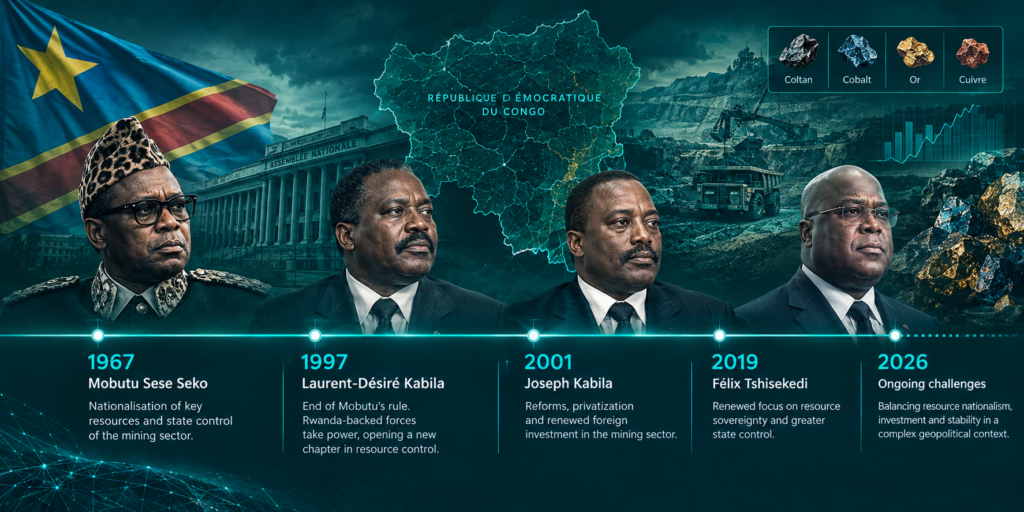
The DRC is the world’s largest cobalt producer and one of its leading copper producers, so the way Kinshasa manages its minerals affects global battery and energy supply chains. Resource nationalism is not new in the country: it runs from the nationalisation of the colonial mining giant in 1967 to the 2018 Mining Code and the cobalt export quotas of 2025. This guide explains the concept, traces its history in the DRC and sets out what it means for investors today.
What is resource nationalism?
Resource nationalism is a set of policies by which a state asserts greater control over natural resources on its territory, either by taking a larger share of revenues, by increasing state or local ownership, or by deciding how, when and to whom resources are sold.
It rarely takes the form of outright expropriation today. More often, it works through a combination of tools:
| Tool | How it works | Example in the DRC |
| Fiscal | Higher royalties and taxes, windfall profit taxes | 10% royalty on cobalt and coltan since 2018; 50% super-profits tax |
| Ownership | Larger free-carried stakes for the state, local ownership requirements | State free-carried interest raised from 5% to 10% in new projects |
| Contractual | Review or renegotiation of existing agreements | Review of 61 mining contracts in 2007; Sicomines renegotiation in 2024 |
| State companies | Stronger role for national champions in production and trading | Gécamines claiming offtake rights; artisanal cobalt monopoly given to EGC in 2019 |
| Trade controls | Export bans, quotas, local processing requirements | Cobalt export suspension in 2025, followed by quotas |
Three drivers usually push governments in this direction. The first is price: when commodity prices rise, governments feel they are not getting a fair share of the windfall. The second is politics: control over natural resources is a powerful theme for national sovereignty, especially in a country with a colonial mining history. The third, more recent, is strategy: as critical minerals become central to the energy transition, producing countries see an opportunity to use their position as leverage.
How has resource nationalism developed in the DRC?
Resource nationalism in the DRC has moved in cycles: periods of state control have alternated with periods of liberalisation, each one shaping the rules investors face today.
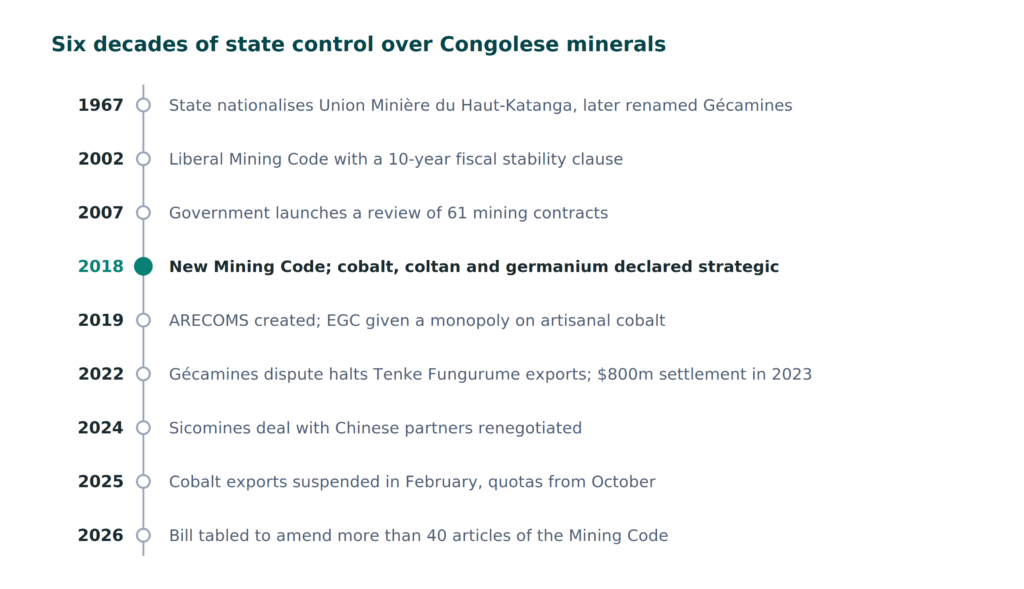
Nationalisation (1967). On 1 January 1967, the government took control of the assets of Union Minière du Haut-Katanga, the Belgian company that had dominated Katanga’s copper since the colonial era. It became a state company, renamed Gécamines in 1971. At its peak in the 1980s, Gécamines provided around 70% of state budget revenue, before collapsing in the following decades.
Liberalisation (2002). After years of war, the 2002 Mining Code opened the sector to private investment with first-come, first-served licensing, uniform taxes and a stability clause guaranteeing investors that the code’s provisions would apply for at least ten years. It succeeded in attracting investors, but many observers concluded that the state captured little of the value created.
The contract review (2007). In April 2007, the government set up a commission to review 60 contracts between state companies and private partners, 61 in practice. The review produced limited results: some access payments and royalties were raised and a few stakes adjusted, but the economics of most contracts did not change.
The return of the state (2018 onwards). The 2018 Mining Code marked a decisive shift back towards state control, followed by a series of measures targeting cobalt in particular. These are detailed in the next sections.
What changed with the 2018 Mining Code?
The 2018 Mining Code is the cornerstone of modern resource nationalism in the DRC. Signed into law by President Joseph Kabila on 9 March 2018, it raised the state’s share of mining revenue, increased state and local ownership, and cut back the protections investors had enjoyed under the 2002 code.
| Provision | 2002 Mining Code | 2018 Mining Code |
| Royalty on copper and cobalt | 2% | 3.5% |
| Royalty on strategic substances | Not applicable | 10% (cobalt, coltan and germanium declared strategic in November 2018) |
| Windfall tax | None | 50% tax on super-profits, when prices exceed feasibility study assumptions by more than 25% |
| State free-carried interest in new projects | 5% | 10% |
| Local ownership | No requirement | 10% of the capital to be held by Congolese private citizens |
| Fiscal stability clause | 10 years | 5 years, with the new code applying immediately to existing projects |
| Duration of mining licences | 30 years | 25 years, renewable for up to 15 years |
Two changes caused the strongest reaction from industry. The first was the 10% royalty on strategic substances, which applies to revenue whether or not a project is profitable. The second was the removal of the ten-year stability clause for existing projects, which many investors had relied on when they bought their licences. According to an analysis by the Natural Resource Governance Institute, the new code could raise the average effective tax rate on a copper-cobalt mine from 48% to 72%.
The code also introduced obligations that go beyond taxation, including community development plans financed by mining companies, and an allocation of 10% of royalties to a fund for future generations.
What are the current trends in DRC resource nationalism?
Since 2022, resource nationalism in the DRC has shifted from rewriting the tax code to actively intervening in production, contracts and trade. Four trends stand out.
- 1. Gécamines is reclaiming its place in joint ventures. The state mining company holds minority stakes in many of the country’s largest copper and cobalt operations. In July 2022, a dispute with CMOC over royalties at the Tenke Fungurume mine, in which Gécamines holds 20%, led to a halt in exports that lasted until April 2023. CMOC agreed to pay $800 million between 2023 and 2028 and at least $1.2 billion in dividends, and gave Gécamines the right to buy a share of production proportional to its stake. Gécamines has said its joint-venture partners can no longer take all of the offtake.
- 2. Historic contracts are being renegotiated. In 2024, the Sicomines deal with Chinese partners was revised to raise infrastructure commitments from $3 billion to up to $7 billion. The message to investors is that agreements considered unbalanced can be reopened.
- 3. The state is managing cobalt supply. In February 2025, ARECOMS, the regulator created in 2019 for strategic substances, suspended cobalt exports to support prices. It replaced the ban with quotas from 16 October 2025, with an annual cap of 96,600 tonnes for 2026 and 2027. This is a new form of resource nationalism: using the DRC’s dominant market position to influence global prices.
- 4. A new revision of the Mining Code is on the table. A bill sent to the government for comment in June 2026 would amend more than 40 articles of the 2018 code. It would expand state control over strategic minerals and allow strategic stockpiles. The Chamber of Mines has called for an impact assessment before any new revision.
In parallel, the DRC is using its minerals as a diplomatic asset. Its Strategic Partnership Agreement with the United States, signed in December 2025, gives US companies preferential access to a reserve of strategic assets, in exchange for investment and security cooperation.
How does resource nationalism affect investors in the DRC?
Resource nationalism affects investors in the DRC by reducing returns, shortening the period over which terms are predictable, and introducing the risk that production or exports can be stopped by state decision.
- Lower and less predictable returns. Higher royalties are paid on revenue regardless of profitability, and the super-profits tax caps the upside in high-price periods. Projects designed under the 2002 code have had to absorb the new terms without the stability they expected.
- Shorter planning horizons. A five-year stability clause is short for mines that need ten to thirty years to recover their capital. Every new mining code revision becomes a risk to the investment case.
- Operational interruption. The Tenke Fungurume export halt and the 2025 cobalt export ban show that disputes with the state or its companies can stop revenue for months.
- Pressure on joint ventures. Gécamines’ push for offtake rights, a share of subcontracting and higher dividends changes the economics of existing partnerships.
- Market risk created by policy. Export quotas make volumes dependent on a regulator’s decisions, which affects offtake contracts and financing.
Resource nationalism is not only a cost, however. Investors who align with the state’s priorities, such as local processing, community investment and transparent partnerships, can gain political support. And the DRC still needs foreign capital and expertise to develop its resources, which limits how far the state can go.
How can investors manage resource nationalism risk in the DRC?
Investors cannot eliminate resource nationalism risk in the DRC, but they can price it, anticipate it and reduce their exposure:
- 1. Model policy change as a base case. Build higher royalties, export quotas and contract renegotiation into financial models from the start, rather than treating them as tail risks.
- 2. Track the legislative pipeline. Monitor the progress of the 2026 Mining Code bill, ARECOMS quota decisions and new decrees on strategic substances, which can change terms quickly.
- 3. Manage the relationship with Gécamines actively. In joint ventures, anticipate demands on offtake, subcontracting and dividends, and make sure reserve and royalty calculations are fully documented.
- 4. Seek available stability mechanisms. Under the US–DRC partnership, qualifying projects can obtain a renewable ten-year fiscal stabilisation clause. Bilateral investment treaties and international arbitration clauses can also provide some protection.
- 5. Align with national priorities. Local processing, local content and visible community investment strengthen a project’s political position.
- 6. Diversify offtake and financing. Avoid relying on a single buyer, route or financier, so that a policy shock in one area does not stop the whole operation.
- 7. Monitor politics, not just regulation. In the DRC, mining policy is driven by politics. The constitutional debate, the budget and the relationship with China, the United States and the EU all shape the next move.
Frequently asked questions
What is resource nationalism in simple terms?
Resource nationalism is when a government takes more control over its country’s natural resources, for example by raising taxes and royalties, increasing state ownership, renegotiating contracts or restricting exports, so that more of the value stays in the country.
What are strategic substances in the DRC?
Strategic substances are minerals designated by the government as being of special importance for the economy or for global markets. Under the 2018 Mining Code, they carry a 10% royalty. Cobalt, coltan and germanium were declared strategic in November 2018.
Is the DRC changing its mining code again?
A bill to amend more than 40 articles of the 2018 Mining Code was introduced in 2026 and sent to the government for comment in June. It would strengthen state control over strategic minerals. Industry has asked for an impact assessment before any new revision.
What is Gécamines?
Gécamines is the DRC’s state mining company. It descends from Union Minière du Haut-Katanga, the Belgian company nationalised in 1967, and holds minority stakes in many major copper and cobalt joint ventures, including Tenke Fungurume and Kamoto Copper Company.
Does resource nationalism make the DRC uninvestable?
No. It makes the DRC more expensive and less predictable, but the country holds some of the world’s richest copper and cobalt deposits, and investment continues. The key is to price policy risk realistically and manage relationships with the state actively.
Conclusion
Resource nationalism is a permanent feature of investing in the DRC, not a passing phase. From the nationalisation of 1967 to the 2018 Mining Code and the cobalt quotas of 2025, the direction of travel has been towards more state control, more state revenue and more active intervention in markets. For investors, the best approach is to understand the logic behind this trend, anticipate its next moves and build projects that can withstand them.
For the wider political context, read What Are the Main Political Risks in the DRC in 2026? and How Does the M23 Conflict Affect Business Operations in the DRC?
Need to assess how resource nationalism affects your project in the DRC? Talk to our team.
About the author: Eli Foster is a geopolitical and security analyst covering political developments, conflict dynamics and emerging risks across Africa. His work focuses on regional security, governance and geopolitical shifts, providing insights into complex environments and their implications for international stakeholders.
Sources
Mondaq: Key changes to the DRC Mining Code
EY Global Tax News: DRC reforms Mining Code, April 2018
Oxfam America: Understanding DRC’s new mining law power play
ISS Blog: New mining code, old problems, by Ben Radley
Mine Magazine: Overhauling the DRC’s mining code
Justice & Paix: Mining code in DR Congo, the challenges of reform
Financial Afrik: Gécamines and its partnerships, December 2024
Wikipedia: Gécamines
CMOC filing on the TFM settlement, July 2023
Mining.com/Reuters: CMOC agrees to pay $800 million to Gécamines
Project Blue: Gécamines may amend joint venture terms
IEA: Ministerial Decree 19/15 on artisanal strategic minerals
Mining.com/Reuters: Congo mines minister seeks to cancel artisanal cobalt monopoly, May 2022
EITI: Sicomines renegotiation
Fastmarkets: ARECOMS on 2026–2027 cobalt quotas
Mining Weekly/Reuters: planned mining law reform, July 2026
Semafor: mining law reform and the US–DRC partnership, July 2026